
Flexibility Adds Function to First-Year Writing Program
Designing a sustainable, mobile, student-centered writing classroom model at NC State
Project Overview & Approach
Higher education writing programs faced a difficult paradox: technology expectations were rising while budgets continued to shrink.
NC State’s First-Year Writing Program—responsible for 225 course sections annually—struggled with aging computer classrooms, costly hardware refresh cycles, and growing frustrations among both instructors and students. University-owned desktops were cumbersome, power cords restricted mobility, and students increasingly brought their own laptops, creating overcrowded, inefficient workspaces.
Working alongside the program director, I conducted research into sustainable, flexible, technologically agile alternatives via ethnographic observations and in-depth interviews. Our goal was to build a classroom model that:
Reduced technology costs
Supported mobile, active learning
Aligned with student behavior (BYOT adoption)
Increased instructor autonomy
Enhanced accessibility and movement within the space
This redesign resulted in NC State’s first flexible writing classroom, providing a new blueprint for modern, cost-effective learning environments.
Exploratory Understanding
1. Understanding the Problem: Cost, Traffic, and Obsolescence
Traditional computer classrooms required continual, expensive hardware updates—$34,700 per room—a cost multiplied across multiple writing classrooms. Heavy usage and a constant rotation schedule introduced maintenance strain and inconsistent classroom experiences.
Students attempting to use their own laptops struggled with limited space, restrictive wiring, and inaccessible outlets. University-owned machines were frequently left unplugged and drained, compounding logistical issues.
2. BYOT (Bring Your Own Technology) as a Transitional Model
We first introduced BYOT sections, which reduced hardware dependency and allowed students to work with their preferred devices.
However, we quickly discovered that:
Tables and desks were static and heavy
Power access still constrained movement
The pedagogy demanded more flexibility than the space allowed
Instructors could not reconfigure the room for different activities
This led to a deeper investigation of learning space design principles and flexible classroom models.
3. Collaborative Research Approach
I partnered with/consulted:
The College IT group
The College of Design
First-year writing instructors
National learning space scholarship
This multi-stakeholder research informed the design specifications for the first fully flexible classroom.
Our research surfaced several insights that drove design direction:
1. Technology Must Support Pedagogy, Not the Other Way Around
Instructors needed the ability to adapt space layout to teaching goals—peer review, small group work, drafting sessions—not be limited by fixed furniture and power constraints.
2. Mobility Is a Core Requirement
Desks, chairs, whiteboards, and screens must be reconfigurable to support active learning methodologies.
3. BYOT Aligns with Student Behavior and Reduces Costs
Students already preferred their own devices. Supporting BYOT eliminates expensive hardware refresh cycles and enables students to work in familiar environments.
4. Flexibility Improves Accessibility
The flexible layout allowed instructors and students with disabilities or mobility limitations to navigate the room more easily.
5. A Functional Space Enhances Engagement
Both instructors and students reported higher engagement, improved collaboration, and smoother transitions between in-class and out-of-class writing work.
Design Exploration
1. NC State’s First Flexible Writing Classroom
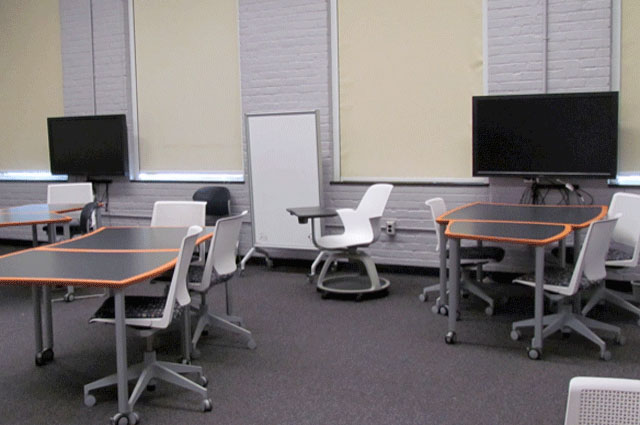
Implemented in 2011, costing $14,500—less than half the cost of a traditional computer classroom.
Key features included:
Mobile, lightweight desks and tables
Movable whiteboards
Rechargeable laptop stations and improved power distribution
Multiple projection screens for student work
Ample open space for group work configurations
2. Hybrid BYOT + Available Checkout Technology
While students were encouraged to bring their own laptops, classroom devices remained available for students who needed them—ensuring technological equity.
3. A Space Designed for Movement and Access
The new design allowed instructors to move freely, support small groups, facilitate collaboration, and adjust the room layout dynamically.
4. Scalable, Sustainable Infrastructure
This model provided a replicable approach that other institutions adopted, including Old Dominion, East Carolina University, and others, demonstrating far-reaching impact.
Project Milestones
2008
BYOT Pilot Launched
Bring Your Own Technology sections launched to reduce hardware dependency and better reflect student behavior.
2010
Research & Redesign Collaboration Begins
Working with the College IT group and the College of Design, I co-lead research into sustainable, flexible learning spaces tailored to writing pedagogy.
2011
NC State’s First Flexible Classroom Implemented
A fully mobile, reconfigurable writing classroom opens—costing less than half of a traditional computer classroom and immediately preferred by instructors and students.
2013
Second Flexible Classroom Designed
Building on research and early success, I led the team to design a new flexible classroom to expand the model within the First-Year Writing Program.
2013
National Recognition & Publication
The project is featured in NC State news, and their co-authored article, “Making Peace with the Rising Costs of Writing Technologies: Flexible Classroom Design as a Sustainable Solution,” is published—leading other universities to adopt similar designs.
Citations & References
Flexibility Adds Function to First-Year Writing Program (NC State News, 2013).
Miller-Cochran, S. & Gierdowski, D. (2013). Making Peace with the Rising Costs of Writing Technologies: Flexible Classroom Design as a Sustainable Solution. Computers and Composition.
Additional related scholarship referenced in the original article and research.