
2020 Student Technology Report
Supporting the Whole Student
Project Overview & Approach
In 2020, higher education faced a convergence of challenges: rapid shifts to remote learning, growing concerns around data privacy and online harassment, and longstanding gaps in accessibility and student support. As part of EDUCAUSE Research, I co-authored the 2020 Student Technology Report: Supporting the Whole Student to better understand how undergraduate students experience technology—not just as learners, but as whole people navigating academic, social, and personal challenges.
This large-scale national study captured responses from 16,162 undergraduate students across 71 U.S. institutions, providing a comprehensive view of how technology intersects with student success, well-being, trust, and access. Our goal was not only to surface key findings, but also to offer actionable guidance institutions could use to improve student experiences during a period of unprecedented disruption.
Rather than focusing on individual tools, the study intentionally examined the full ecosystem of student technology experiences, including learning environments, communication systems, institutional policies, and support structures

Study Design & Scope
The research was conducted as part of EDUCAUSE’s long-running Students and Technology Studies. The 2020 iteration included:
- A national survey of 16,162 undergraduate students
- Representation from 71 U.S. colleges and universities
- Analysis spanning academic, environmental, and social dimensions of technology use
- Integration with prior years of longitudinal EDUCAUSE data
The study examined student experiences across multiple domains, including student success initiatives, technology use and environmental preferences, data privacy, online harassment, and accessibility.
Key Research Areas
The research explored how technology affects students in five interconnected areas:
- Student success and early alert systems
- Technology use and physical study environments
- Institutional data privacy and trust
- Online harassment and equity
- Accessibility and accommodations for students with disabilities
This holistic framing allowed us to identify patterns that might otherwise be missed in single-topic studies.
1. Technology Plays a Critical Role in Student Success
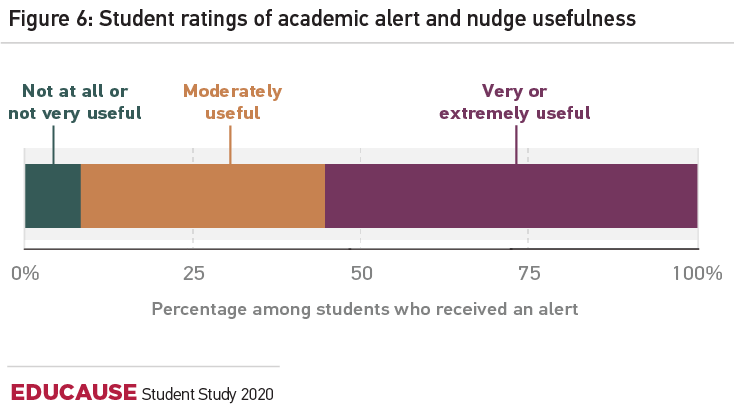
Students who received early alerts, nudges, or proactive outreach reported overwhelmingly positive experiences. 92% found these interventions at least moderately useful, underscoring the importance of technology-enabled advising and support systems
2. Environment Matters More Than Devices
When studying, students consistently ranked Wi-Fi access as the most important technology, followed by access to power outlets. Devices themselves—printers, phones, computers—were far less important than reliable connectivity and functional spaces
3. Data Privacy Gaps Undermine Trust
Many students lacked a clear understanding of how their institutions collect and use personal data. This uncertainty weakened both trust and confidence in institutional data protection practices
4. Online Harassment Disproportionately Affects Marginalized Students
While much harassment occurred in non-institutional spaces, students from marginalized racial and ethnic groups were more likely than white students to experience harassment in institution-provided or sponsored platforms
5. Accessibility Remains Inconsistently Supported
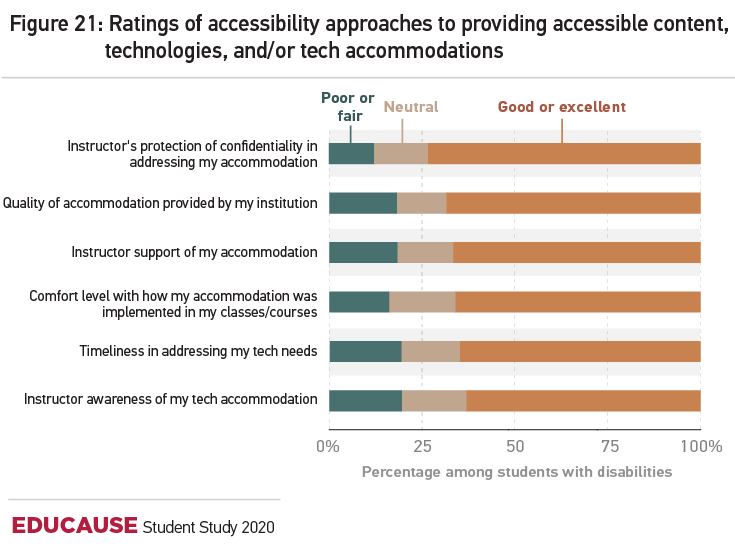
Students with disabilities reported mixed—and often negative—experiences with accessible content and technology accommodations, highlighting persistent gaps between policy and practice
1. Technology Plays a Critical Role in Student Success
Students who received early alerts, nudges, or proactive outreach reported overwhelmingly positive experiences. 92% found these interventions at least moderately useful, underscoring the importance of technology-enabled advising and support systems
2. Environment Matters More Than Devices
When studying, students consistently ranked Wi-Fi access as the most important technology, followed by access to power outlets. Devices themselves—printers, phones, computers—were far less important than reliable connectivity and functional spaces
3. Data Privacy Gaps Undermine Trust
Many students lacked a clear understanding of how their institutions collect and use personal data. This uncertainty weakened both trust and confidence in institutional data protection practices
4. Online Harassment Disproportionately Affects Marginalized Students
While much harassment occurred in non-institutional spaces, students from marginalized racial and ethnic groups were more likely than white students to experience harassment in institution-provided or sponsored platforms
5. Accessibility Remains Inconsistently Supported
Students with disabilities reported mixed—and often negative—experiences with accessible content and technology accommodations, highlighting persistent gaps between policy and practice
Project Milestones
2019
National Data Collection Completed
EDUCAUSE gathers student responses as part of its annual Students and Technology Study.
October 2020
Report Published
2020 Student Technology Report: Supporting the Whole Student is released, providing institutions with data-driven insights and recommendations
2020
Executive Summaries & Infographics Released
Findings are translated into interactive graphics and briefs to support institutional decision-making.
2020+
Institutional Adoption & Influence
The report informs technology planning, student success initiatives, accessibility efforts, and policy discussions across higher education.
Citations & References
Gierdowski, D. C., Brooks, D. C., & Galanek, J. (2020). 2020 Student Technology Report: Supporting the Whole Student. EDUCAUSE Research
2020 Student Technology Report-…
EDUCAUSE Students and Technology Studies (2004–present).
Related EDUCAUSE Research on accessibility, student success, online learning, and learning environments.
- 2020 Student Technology Report: Supporting the Whole Student